Evidence Aware Past Life Regression Benefits for Anxiety, Purpose


Past life regression benefits tend to cluster in three areas: emotional release from feelings that don’t seem to trace back to anything in your current life, psychological clarity about patterns you keep repeating, and a shift in how you relate to death and purpose. Many practitioners see genuine clinical value in this work even when the memories surfacing are understood as metaphor rather than literal history. The sections below cover what the evidence actually shows, who tends to benefit, and how to prepare if you decide to try a session.
TL;DR:
Past life regression tends to best help those with unexplained fears or anxieties, especially when current life experiences cannot explain them.
Emotional release is often the most consistent benefit, with about 80% of respondents reporting decreased fear of death and increased life satisfaction.
The strongest therapeutic gains come from pairing regression with breathwork and proper follow-up, rather than relying on regression alone.
Evidence mainly shows rapid symptom relief based on self-report, but lack of controlled trials means claims of literal past life memories are uncertain.
Physical benefits are rare and should not be the primary reason for trying regression, while emotional and spiritual shifts are most reliably reported.
Table of Contents
What emotional, psychological and spiritual gains actually look like
Regression sessions rarely produce a single, tidy outcome. Most clients describe a layered experience: something releases emotionally, something clicks psychologically, and something shifts in how they see their place in the world. Each layer works slightly differently, and it helps to understand them separately before you book anything.
Emotional release and catharsis
The imagery that surfaces during a session, whether you take it as a literal past life or a construction of the subconscious mind, gives feeling a shape it didn’t have before. A client who has spent years anxious around water with no memory of a bad experience might, during regression, encounter a scene of drowning. The point isn’t proving the scene happened. It’s that naming an unexplained dread often lets it discharge. Regression practitioners describe this as body-memory work: emotion gets discharged and reframed once it has a narrative container to sit inside, rather than floating free as generalised unease.
Phobias respond particularly well to this re-contextualisation. Fear that once felt irrational and shameful becomes, within the session, a response that made sense somewhere, sometime. That shift in framing, from “this is broken in me” to “this response made sense once”, is often what unlocks the anxiety rather than any factual claim about reincarnation.
Psychological insight and breaking repeating patterns
Regression work is unusually good at surfacing patterns clients already half-recognise but haven’t named. Someone who keeps choosing controlling partners, or keeps sabotaging promotions right before they land, often uses the regression narrative to see the shape of the pattern from a distance. That distance is the useful part. A client who “sees” a repeated dynamic playing out across several regressed scenes tends to describe more insight into a current relationship than someone told the same thing directly by a therapist.
Improved life satisfaction is one of the more consistently surveyed outcomes, alongside a reduced fear of death; survey research into past life regression outcomes found roughly 80% of respondents reported death no longer held as much fear for them afterwards, alongside high ratings on general life satisfaction items.
Spiritual benefits: purpose, death and connectedness
This is where past life regression tends to diverge most sharply from standard talking therapy. Clients frequently report a sense of connectedness that outlasts the session itself. A felt sense that their current struggles sit inside something larger than one lifetime, and that this larger frame is not something to fear.
Reduced fear of death is the single most commonly reported spiritual shift.
A stronger, more specific sense of purpose, often described as “finally understanding why I keep doing this to myself.”
A feeling of connectedness to other people, sometimes framed as recognising a soul group or recurring relationship.
Physical symptom relief does occur in case reports, but it’s the rarest of the reported benefits and should be treated as a possible bonus, not an expectation.
Pro Tip: If you’re going into a session hoping mainly for physical healing, recalibrate. The strongest, most consistently reported gains are emotional and spiritual. Treat any physical shift as a welcome extra, not the goal.
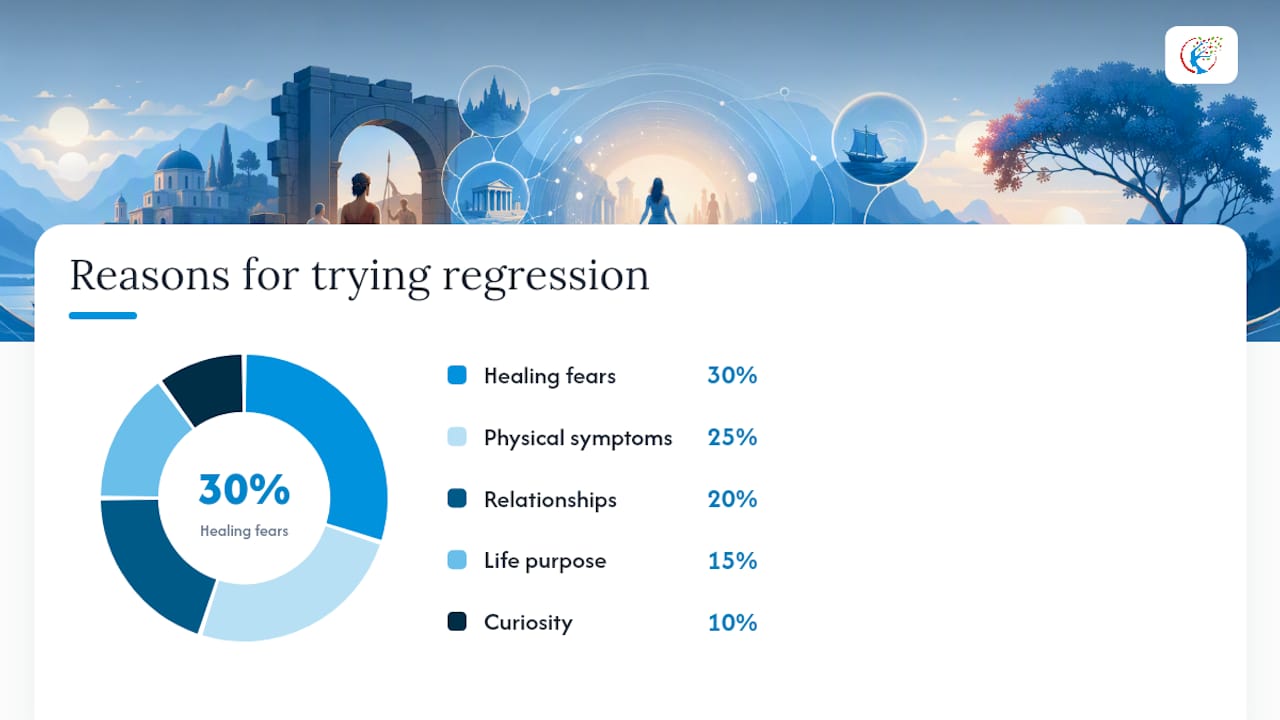
Practitioner writing on the five most common reasons people try past life regression lists healing fears and patterns, exploring physical symptoms, understanding relationships, clarifying life purpose, and plain curiosity, in roughly that order of frequency. Deep emotional release tends to show up most reliably when the session pairs regression with breathwork and proper integration afterwards, rather than the regression alone.
What the evidence actually says (and where it falls short)
The research base for past life regression is thin compared with mainstream cognitive therapies, but it isn’t empty, and what exists is worth reading carefully rather than dismissing outright.
A ten-year case series is the most cited piece of quantitative evidence in the field. It measured Subjective Units of Distress (SUDs), a standard self-report pain and distress scale, before and after regression sessions.
Statistic: Across the case series, average SUDs scores fell from 7.9 to 0.9, with most clients needing only 1.6 sessions on average to see that shift, according to research published in The International Journal of Regression Therapy.
That’s a striking number, and it deserves an honest caveat rather than a celebratory one. This wasn’t a randomised controlled trial. There was no comparison group receiving a placebo intervention, and the outcome measure was self-reported. Rapid symptom change after one or two sessions is a real pattern the data shows, but the study design can’t rule out expectation effects or the natural fluctuation of pain over time.
Mainstream clinical overviews are blunter still. The PSI Encyclopedia’s review of regression therapy treats recovered “memories” as most plausibly confabulation, imagination, or metaphor rather than literal evidence of past lives, while still acknowledging that therapeutic value can persist regardless of historical accuracy. That distinction, between “this happened” and “this helps”, is the one most critics and most practitioners can actually agree on.
A useful framework for weighing any claim you encounter:
Self-reported improvement after one session tells you something happened, not why.
A case series with dozens of clients is stronger evidence than a single testimonial, but weaker than a controlled trial.
Belief in literal reincarnation isn’t a prerequisite for benefit. A student literature review of past life regression found metaphorical interpretation delivers comparable therapeutic outcomes to literal belief.
Watch for language that promises a guaranteed cure. Genuine practitioners describe probabilities and typical patterns, not certainties.
Who tends to benefit most from a session
Regression work isn’t evenly effective. Certain profiles show up again and again in the case reports and practitioner accounts as getting the most out of it.
People with unexplained phobias or anxieties that don’t trace to any identifiable event in their current life tend to see some of the fastest, clearest shifts.
Spiritual seekers already comfortable with symbolic or non-literal frameworks generally get more from the experience than sceptics looking for hard proof.
Anyone chasing clarity on life purpose, especially at a transition point like a career change or a major loss, often finds the narrative structure of regression useful for reframing that transition.
Chronic physical illness treated as a standalone target responds far less reliably. Physical symptom relief happens in some case reports, but it’s the least consistent outcome and shouldn’t be the primary reason you book.
Openness to imagery and a willingness to engage with what surfaces, rather than analysing it in real time, predicts outcome more strongly than any prior belief in reincarnation. Most clients need only one to two sessions to notice a shift, consistent with the session counts reported in the case series above, though some return periodically for deeper layers of the same theme.
Inside a typical regression or QHHT session
A first session usually runs longer than people expect, and that length is deliberate rather than padding.
Intake and goal-setting. You’ll talk through what you want to explore, whether that’s a specific fear, a recurring relationship pattern, or general curiosity about purpose, before any induction begins.
Induction. Most practitioners use a combination of breathwork, guided imagery and progressive relaxation to move you into a deeply relaxed, hypnotic state. You remain aware and in control throughout.
The regression itself. Imagery, sensation or a sense of “knowing” tends to surface, sometimes as vivid scenes, sometimes as fragments or feelings without a clear picture. Bodily and emotional responses, tears, tension, sudden relief, are common and considered part of the process.
Integration. After the session, practitioners typically guide you through grounding exercises and a short conversation about what came up, often recommending journalling and other integration practices in the days that follow to help the insight settle rather than fade.
QHHT sessions are usually packaged as one long, immersive appointment, often several hours, while standard regression hypnotherapy sessions tend to run shorter and can be repeated over several visits depending on what you’re working through.
Pro Tip: Book a quiet afternoon after your session, not a packed evening. Integration works better when you’re not rushing straight back into email and errands.
Safety, contraindications and when to seek other support
Strong emotion during a session is normal and usually short-lived. What matters is how a practitioner handles it.
Active psychosis or severe, unmanaged mental illness is a clear contraindication for regression work; these presentations need conventional clinical care first.
If you’re on psychiatric medication or have a diagnosed condition, tell your practitioner beforehand so the session can be adapted or, if appropriate, declined.
Be wary of anyone promising a guaranteed cure for physical illness, since clinical guidance from the American Psychological Association stresses verifying a therapist’s actual training rather than taking marketing claims at face value.
No informed consent process, or pressure to continue once you’ve said you want to stop, is a red flag regardless of how experienced the practitioner claims to be.
If you’re managing an acute mental health crisis, prioritise NHS mental health services or your GP over any regression session. Past life work sits alongside conventional care for many people; it isn’t a substitute for it when symptoms are severe or active.
How to choose a practitioner and get ready for your session
Picking the right practitioner matters more than picking the right technique. Here’s a practical sequence for vetting and preparing.
Ask directly about training and certification, and how long they’ve practised regression or QHHT specifically.
Ask what a typical session involves, including how long it runs and what happens if strong emotion comes up.
Ask about aftercare. A good practitioner has a clear integration plan, not just a wave goodbye at the door.
Check whether informed consent is built into the process from the first conversation, not tacked on as a form to sign.
Compare pricing against a UK price guide for past life regression so you know what’s reasonable before you book.
Red flags to watch for in marketing: guaranteed cures, claims of scientifically “proven” past lives, or pressure to book multiple sessions upfront before you’ve even had one. A practical safety guide to trying past life regression covers this in more depth if you want a fuller checklist.
Before the session itself, keep preparation simple: sleep properly the night before, stay hydrated, and spend ten minutes writing down what you actually want to explore. Afterwards, ritual objects and grounding routines can meaningfully reduce anxiety during integration, and a short journalling habit in the following week helps insights stick rather than fade within a few days.

Why I treat the memories as secondary to the healing
I don’t need a client to believe they were a Victorian blacksmith or a soldier at Waterloo for a session to work. What I care about is whether the imagery that surfaces gives them something to work with, a shape for a feeling that previously had none. That’s the part sceptics and true believers both underestimate: the mechanism matters less than the material it produces.
What I see most often isn’t dramatic past life detail. It’s people recognising a pattern they’ve been living inside for years, sometimes decades, and finally getting enough distance from it to change course. Fear around death softens. A sense of “why do I keep doing this” gets an answer, even a symbolic one. I build sessions around a calm, unhurried pace precisely because rushing the process is where clumsier regression work goes wrong, and I always talk clients through grounding and follow-up before they leave, because the days after a session matter as much as the session itself.
— Paul
Book a session or explore the services
If any of this resonates, the practical next step is straightforward: book a session and see what surfaces. QHHT and regression hypnotherapy sessions are built around exactly the benefits covered above, emotional release, psychological insight, and a shift in how you relate to fear and purpose, alongside energy healing work such as Reiki, chakra balancing and cord cutting for clients wanting support that goes beyond the regression itself. Sessions run with a clear intake conversation, an unhurried induction, and proper aftercare built in, not tacked on.
Pricing and session length are provided before you book. If you’d rather build understanding gradually, an online course for anxiety and depression offers structured exercises you can work through at your own pace. For those ready to try regression directly, you can book a QHHT healing session now, or read the QHHT FAQ first if you want more detail on what the technique involves before committing.
Sources
This article is general information, not a substitute for advice from a qualified doctor. Consult a qualified healthcare professional about your own circumstances before acting on anything here.
Recommended
Comments