Mindfulness for anxiety: the QHHT and energy-healing route


Mindfulness for anxiety, in the sense that matters here, means Quantum Healing Hypnosis Technique (QHHT) and energy healing. Neither is a guided meditation app or a body-scan script. Both work by taking you into a deeply relaxed, receptive state where the nervous system can downshift and the subconscious mind can surface material that everyday awareness cannot reach.
Two things make this different from talking therapy alone. First, the somnambulistic trance used in QHHT activates a parasympathetic, rest-and-digest state far more completely than ordinary relaxation. Second, contact with what practitioners call the Higher Self often surfaces the root of an anxiety pattern rather than just its symptoms, which is what allows the change to hold.
If that sounds like the depth of work you have been looking for:
Read through what a session actually involves before you book
Book a discovery call to ask questions and check the approach suits you
Key Takeaways
QHHT and energy healing work by combining somnambulistic trance, Higher Self contact and hands-on energy techniques to shift the nervous system out of chronic anxiety and address its subconscious roots.
Point | Details |
Trance depth matters | QHHT deliberately reaches somnambulism, a far deeper state than standard relaxation, to enable Higher Self contact. |
Evidence is practice-based | Reported benefits come from consistent practitioner and client observation, not large clinical trials, so treat claims accordingly. |
Safety checks come first | Active psychosis, unmanaged bipolar disorder and active suicidal ideation are reasons to seek clinical care before booking. |
Aftercare sustains results | Rest, hydration, journalling and short daily grounding practices help nervous-system gains hold between sessions. |
Paulstebles offers a direct route | QHHT sessions, standalone energy healing and the Rising Higher online course each match a different starting point for this work. |
This article is general information, not a substitute for advice from a qualified doctor. Consult a qualified healthcare professional about your own circumstances before acting on anything here.
Table of Contents
What QHHT and energy healing mean for anxiety
QHHT works through a somnambulistic trance, a level of relaxation deeper than standard hypnosis or sleep, where the conscious mind steps back and the subconscious, often referred to as the Higher Self, becomes directly accessible. Dolores Cannon’s original method describes this state as the gateway to information and healing requests that the waking mind simply cannot retrieve on its own.
A typical session moves through several distinct stages:
Deepening into trance through guided induction, moving well past the light relaxation used in most therapeutic settings
Facilitating contact with the Higher Self, often following a period of past-life or memory exploration
Conducting a body scan, where the Higher Self is asked to identify the roots of anxiety, tension or physical discomfort
Making healing requests during the scan, followed by energy techniques such as Reiki or chakra clearing to support the nervous system as it settles
Reiki and chakra work sit alongside QHHT as separate but complementary practices. They use hands-on or remote energy transfer to encourage the body out of a stress response and into a grounded state, which practitioners describe as key to letting insight from a session actually stick.
This is worth saying plainly: nothing here covers MBSR, guided body-scan meditation apps, or the mainstream mindfulness techniques you might find elsewhere. This is a different discipline entirely, working through trance and energy rather than moment-to-moment awareness training.
Who benefits, and where caution is needed
QHHT and energy healing tend to suit people whose anxiety has a story behind it. If you have tried conventional routes and still feel like something underneath the anxiety has never been addressed, this kind of work is built for exactly that gap.
People who often report benefit include:
Those with long-standing anxiety they feel is tied to emotional or even inherited patterns
Spiritual seekers wanting insight into purpose, blockages or recurring life themes
Anyone open to past-life regression or Higher Self work as a route to self-understanding
Some situations call for real caution, and a responsible practitioner will say so directly:
Active psychosis or unmanaged bipolar disorder, where deep-trance states are not appropriate
Active suicidal ideation, which needs immediate clinical support before anything else
Recent severe trauma that has not yet been stabilised with a mental health professional
Pregnancy, where some practitioners apply extra precautions around induction techniques
Pro Tip: Before booking anywhere, ask directly whether the practitioner works in person or remotely for QHHT. Most reputable practitioners treat in-person sessions as the safer protocol for this depth of trance, since it allows real-time monitoring throughout.
What happens during a QHHT and energy-healing session
The session begins with intake, not induction. You will talk through your history, your intentions and specific questions you want answered, whether that is about anxiety, a physical symptom or a recurring life pattern.
From there, the session typically unfolds like this:
A guided induction eases you into progressively deeper relaxation
Regression work follows, often involving past-life scenes, before the practitioner facilitates contact with the Higher Self
Once contact is established, a body scan identifies where anxiety or physical tension originates
Healing requests are made, sometimes paired with Reiki or chakra balancing to support the shift
You are gently brought back to full waking awareness, with time to talk through what surfaced
QHHT’s official materials describe this as an intentionally deep process, and full sessions commonly run several hours given the time needed for induction, exploration and integration afterwards. That length is not padding. It reflects how much unfolds once the subconscious is genuinely accessible.
Immediately afterwards, most people feel some combination of deep calm and physical tiredness, occasionally with tears or emotional release as material surfaces and settles. The nervous system reset that follows is usually described as a felt shift rather than an intellectual one, and integration tends to continue over the following days as the body catches up with what the mind has processed.
What the evidence actually shows
Founder materials on QHHT describe reported instantaneous healings and profound shifts following Higher Self contact, and Dolores Cannon’s own writing treats these as central to the method’s value. A UK-based practitioner directory frames the body scan and Higher Self communication as capable of revealing causes behind conditions that talk therapy alone has not resolved.
On the energy-healing side, practitioner write-ups on Reiki describe parasympathetic activation, improved sleep and reduced anxiety frequency building across a series of sessions rather than from one visit alone.
Practitioners are consistent on one point: clients often report immediate relaxation and a real drop in anxiety intensity, but this comes from practice-based observation and testimonial evidence, not from large randomised clinical trials. That gap matters, and it is worth going in with clear eyes about it.
None of this amounts to a clinical cure, and no responsible practitioner will claim otherwise. What exists is a substantial, consistent body of client-reported outcomes alongside founder and practitioner documentation, sitting apart from the kind of large-scale trial evidence that underpins mainstream psychological treatments.
Preparing for a session and supporting the work afterwards
What you do before and after a session shapes how much of it actually sticks. Preparation matters as much as the session itself.
Before booking, be upfront about:
Any medications or mental health history that might affect suitability for trance work
Whether the practitioner insists on in-person sessions for QHHT, and why
Their training, certification and how long they have practised
At the point of booking, ask about:
How long the session runs and what a typical structure looks like
What follow-up support exists if difficult material surfaces
Cancellation and rescheduling terms, and whether remote options exist for energy work specifically
Afterwards, aftercare is not optional extra credit. Rest properly, hydrate, and give yourself space rather than diving straight back into a demanding day. Practitioner grounding toolkits commonly recommend short daily grounding practices, sometimes just two or three minutes, to anchor the nervous-system shift between sessions. Journalling what surfaced helps too.
Pro Tip: Keep a short voice note or written record straight after your session, before daily life crowds it out. Insights from Higher Self contact tend to fade quickly if they’re not captured within the first day or two.
If anxiety spikes sharply or new distressing material emerges that feels unmanageable, that is the signal to bring in a mental health professional alongside this work, not instead of it.
Scientific evidence supporting mindfulness for anxiety
The clearest evidence for this approach comes from practitioner-documented patterns rather than laboratory trials, and it is important to be honest about that distinction. What exists is consistent, practice-based observation: energy work correlated with measurable shifts in subjective stress and sleep quality, and QHHT sessions followed by reported drops in anxiety intensity that clients attribute directly to the Higher Self work and body scan.
Practitioners describe these outcomes as most reliable when the sessions form part of a rhythm rather than a single visit. Reiki practitioners in particular note that nervous-system regulation deepens across a series of sessions, with early sessions producing noticeable relaxation and later ones producing more durable change in baseline anxiety levels.
The honest caveat stands alongside this: there is no substantial body of large randomised controlled trials validating QHHT or energy healing the way there is for cognitive behavioural therapy or medication. What practitioners have is decades of client testimony, founder documentation, and observed patterns that repeat consistently enough to be taken seriously, without being mistaken for clinical proof. Anyone offering you certainty beyond that is overstating the case. The honest position is that this work produces real, frequently reported benefits for many people, sitting within a different evidence tradition than a pharmaceutical trial, and that distinction should shape your expectations rather than your decision to try it.
Different techniques within this approach and what each targets
QHHT and energy healing are not one single technique. Each element targets a slightly different layer of anxiety, and understanding the difference helps you know what you are booking.
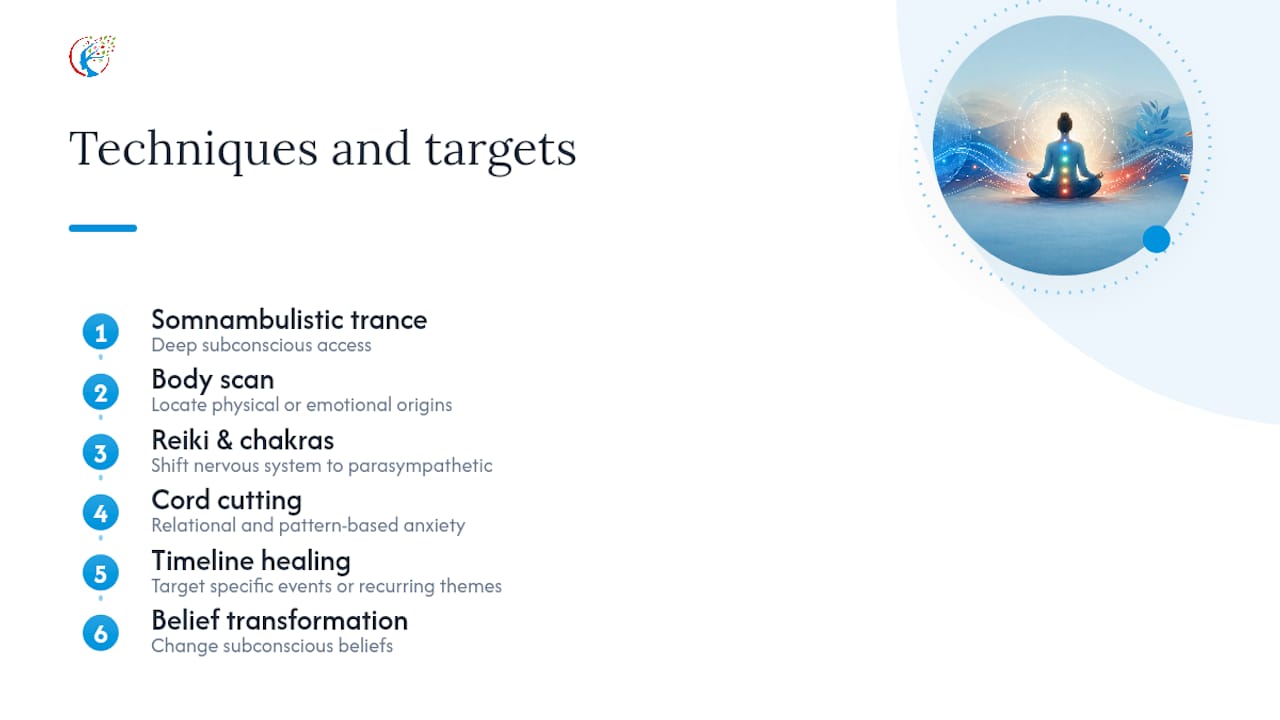
Somnambulistic trance induction is the foundation. It takes you past the light relaxation used in most therapeutic settings into a state deep enough for genuine subconscious access, which is what makes Higher Self contact possible at all.
The body scan works differently again. Once the Higher Self is reached, the practitioner asks it to identify where anxiety originates physically or emotionally, sometimes revealing patterns tied to old experiences or, in some clients’ accounts, past-life material. This is diagnostic as much as therapeutic.

Reiki and chakra balancing target the nervous system directly rather than working through insight. Hands-on or remote energy transfer aims to shift the body from a sympathetic, stress-primed state into a parasympathetic one, and practitioners often pair this with the body scan so the physical settling reinforces whatever surfaced during it.
Cord cutting and timeline healing address relational and pattern-based anxiety specifically, useful where anxiety seems tied to a particular relationship, event or recurring life theme rather than a general baseline of stress. Belief transformation work, meanwhile, targets the subconscious beliefs that keep generating anxious thoughts long after the original trigger has passed. Each of these can be used alone, though most practitioners combine several within a single extended session for compounding effect.
Bringing this work into daily life
A single session, however profound, will not undo years of an anxious nervous-system baseline on its own. What sustains the shift is what happens in the weeks between sessions.
Grounding is the daily anchor. Short practices, sometimes just a few minutes of conscious breathing or a body-based grounding exercise, help maintain the parasympathetic state a session establishes. Guided meditations designed to reinforce this are far more useful daily than trying to recreate trance work alone, which is not something to attempt without a practitioner.
Journalling plays a bigger role than most people expect. Writing down what surfaced during a session, and noticing when old anxiety patterns resurface between sessions, gives you material to bring back to a practitioner and helps you track whether the work is actually holding.
Structured daily practice matters too. Paul Stebles’ Anxiety and Depression Masterclass and the accompanying online course exist precisely because one-off sessions work best alongside consistent daily tools, not instead of them. For simple grounding exercises you can slot into a busy day, resources like Mindpanda’s mindfulness activities for anxiety offer accessible short practices worth building into a morning or evening routine.
The pattern that holds best is simple: a session establishes the shift, daily grounding maintains it, and the next session builds on where the last one left off.
How this compares with other anxiety treatments
Cognitive behavioural therapy works at the level of thought patterns, gradually restructuring how you interpret anxious triggers over weekly sessions across several months. It has the strongest clinical trial base of any anxiety treatment and works well for people who respond to structured, logical reframing.
Medication, typically SSRIs or benzodiazepines for short-term relief, changes anxiety at a neurochemical level. It works quickly for some people and carries the most robust evidence base, but it treats symptoms rather than root causes, and many people using it long-term still want to understand what is actually driving the anxiety underneath.
QHHT and energy healing sit apart from both. Rather than restructuring thoughts or altering neurochemistry, this approach aims to access the subconscious origin of an anxiety pattern directly and shift the nervous-system baseline through trance and energy work. It suits people who have tried more conventional routes and still feel something unaddressed, or who want the insight-driven, spiritual dimension that neither CBT nor medication offers.
These are not mutually exclusive. Many people combine ongoing clinical care with QHHT or energy healing precisely because each works on a different layer of the problem. Anyone on medication or in active therapy should mention this during intake so a practitioner can tailor the session appropriately, and anyone with more acute clinical needs should treat this work as a complement to psychological or psychiatric care, never a replacement for it.
Getting started with this work
Starting is simpler than most people expect once you know what to look for. The first real decision is whether you want a full QHHT session, ongoing energy-healing sessions, or a structured course you can work through independently.
If you are drawn to the depth of subconscious work, a full QHHT session is the natural starting point, and reading through a QHHT FAQ beforehand will answer most practical questions about what to expect. If ongoing nervous-system regulation feels like the priority, particularly if anxiety shows up as chronic tension or poor sleep, energy healing sessions on their own are often the better entry point since they need less time and less preparation than a full QHHT session.
For anyone wanting to build daily skills before or alongside sessions, Paul’s Rising Higher online course offers structured video content and exercises you can work through at your own pace. It suits people who process better through consistent daily practice than through a single intensive session.
Whichever route you choose, come prepared with a clear sense of what you want to understand or shift. Vague intentions produce vague results in this kind of work far more than in conventional therapy, where the structure does more of that work for you.
Common pitfalls to avoid
Expecting a single session to resolve years of anxiety is the most common mistake. Practitioners are consistent that lasting nervous-system change tends to follow a rhythm of sessions and consistent aftercare, not a one-off fix, however powerful that first session feels.
Skipping aftercare is a close second. Diving straight back into a demanding schedule after a session, without rest or grounding time, undercuts the integration the nervous system needs to actually retain what shifted.
Going in with rigid expectations about what will surface can also backfire. The Higher Self work at the centre of QHHT does not follow a script, and clients who arrive fixated on a specific outcome sometimes miss what the session is actually offering them.
Finally, treating this as a substitute for urgent clinical care is a genuine risk worth naming directly. Anyone in acute crisis, with active suicidal ideation, or with unmanaged severe mental illness needs conventional clinical support first and foremost. This work complements that care well. It should never replace it.
How I work with anxiety clients
I treat safety as the foundation, not an afterthought. Every session starts with proper intake, because deep-trance and energy work only helps when someone is genuinely ready for it, and I would rather turn away a booking than rush someone into it.
Beyond individual sessions, the Anxiety and Depression Masterclass and my online course give people ongoing tools between sessions. If you are unsure where to start, book a discovery call. Many clients tell me that conversation alone answered questions no amount of reading could.
— Paul
Booking a QHHT or energy-healing session with Paulstebles
If reading about the body scan and Higher Self work has you thinking “that’s what I need”, the practical next step is straightforward. For deep subconscious exploration and past-life or root-cause work, QHHT sessions are the direct route, whether you prefer coming to Orpington in person or, where suitable, arranging a mobile session. For chronic tension, poor sleep or a nervous system stuck in overdrive, standalone energy healing sessions using Reiki and chakra work are often the faster, lower-commitment entry point. If you would rather build skills gradually and privately, the Rising Higher course gives you structured exercises to work through at home.
A discovery call is free and unpressured. We talk through what you are hoping to shift, whether QHHT, energy healing or the course fits best, and what a first session would actually involve for you specifically, not a generic script. Client testimonials on the site reflect exactly this: people who came in unsure and left with a clear next step. Head to the QHHT and energy healing FAQ to see common questions answered, then book your discovery call directly through the Paulstebles service pages when you are ready to move from reading to doing.
Sources
Recommended
Comments