Past life regression guide: how to try it safely


For most beginners, the right starting point is a short self-guided session at home. If you are carrying something heavier — recurring anxiety, grief, a phobia with no clear origin — book a qualified QHHT or regression hypnotherapy practitioner instead. That is the honest short answer, and everything below unpacks it.
Three things you can do right now:
Try a self-guided script of moderate length in Section 5 tonight, recorded in your own voice.
Write down one clear intention before you start: a question, a pattern, or a feeling you want to understand.
If you are in the UK and want professional support, check availability with a trained QHHT practitioner such as Paulstebles in Orpington before booking anything.
Safety first. People with active PTSD, dissociative disorders, psychosis, or recent severe trauma should not attempt self-guided regression. If any of those apply to you, speak to your GP or a mental health professional before exploring this work. This guide is general information, not clinical advice.
Pro Tip: Write your intention on paper before you begin. Vague curiosity produces vague sessions. “Why do I keep sabotaging close relationships?” produces something you can actually work with.
Table of Contents
How to prepare your environment and yourself before a session
How to integrate insights after a past life regression session
How do you find a qualified regression practitioner in the UK?
Is past life regression real? Evidence, false memories, and how to interpret experiences
Why careful facilitation matters more than most people realise
What is past life regression and which methods can you use?
Past life regression is a technique that uses a relaxed, hypnotic, or meditative state to access memories or impressions that feel as though they belong to a life lived before the present one. Whether those impressions are literal memories, symbolic constructs, or the subconscious mind processing current-life material is genuinely debated. What is consistent across thousands of reported sessions is that the experience often feels meaningful and that many people leave with insights they find useful.
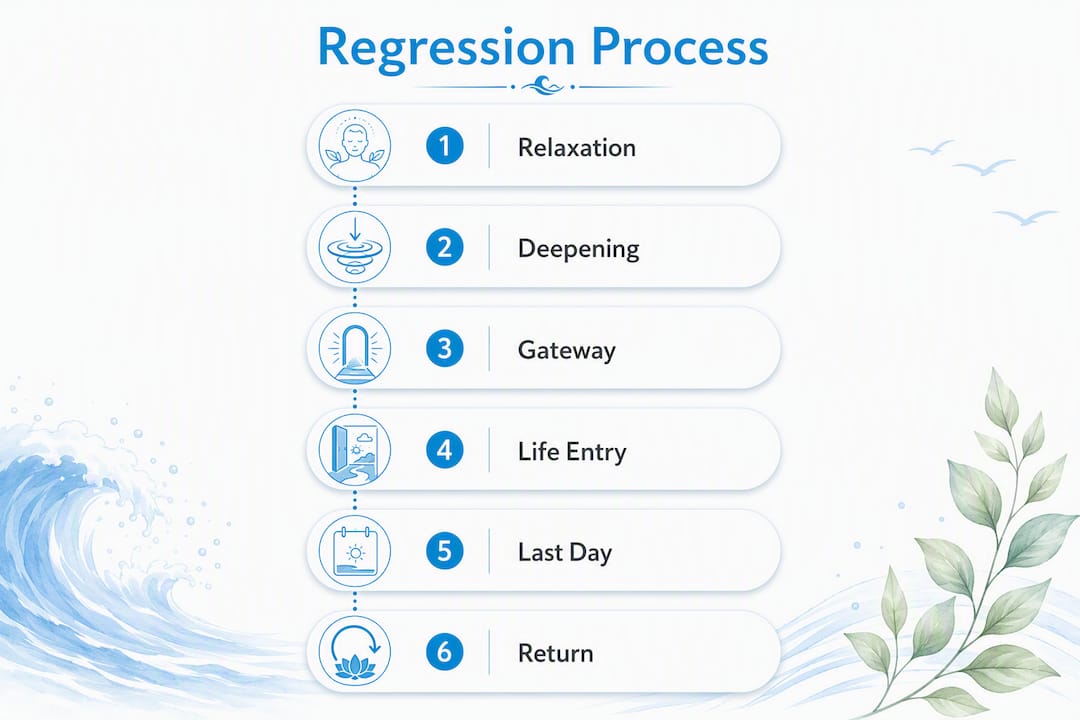
The four main approaches differ mostly in depth and setting:
Self-guided visualisation uses a recorded or read script to guide you through relaxation and imagery. You remain in control throughout. It suits curious beginners and people who want a low-stakes first attempt.
Guided meditation is similar but often shorter, typically 20–47 minutes, and available on mainstream platforms such as Insight Timer. Scripted tracks on these platforms include preparation, induction, exploration, and grounding cues, making them accessible without any prior experience.
Regression hypnotherapy involves a trained therapist who uses hypnotic induction to guide you into a deeper state. The therapist can respond to what arises in real time, which is particularly useful when emotional material surfaces unexpectedly.
Quantum Healing Hypnosis Technique (QHHT) was developed by Dolores Cannon and takes regression further. A QHHT session typically includes exploration of one or more past lives, a “Last Day” review of the final moments of each life, and a conversation with what practitioners call the Higher Self or Subconscious. Sessions commonly move through layered states from present-life review through childhood, in-utero impressions, and then into past-life material. QHHT is always practitioner-led and runs considerably longer than a standard hypnotherapy session.
The purpose across all methods is broadly the same: insight, healing, pattern resolution, or simple curiosity about what the subconscious holds.
Who should try past life regression, and who should wait?
Regression tends to attract people who have already tried more conventional routes and still feel something unresolved. Common reasons people seek it out:
Phobias or fears with no obvious cause in this lifetime
Repeating relationship or behavioural patterns that resist ordinary therapy
Grief, particularly complicated grief after sudden loss
A persistent sense of purpose or calling that feels disconnected from current circumstances
Creative blocks or unexplained physical symptoms that have no clear medical origin
Spiritual curiosity about the nature of consciousness and continuity
None of these require a clinical diagnosis. Regression is not psychotherapy, and most people who try it are simply curious or seeking a different angle on something they already understand partially.
Who should not attempt self-guided regression:
Active PTSD or complex trauma: the relaxed state can lower defences and allow traumatic material to surface without the containment a trained therapist provides.
Dissociative disorders: regression deepens dissociation rather than resolving it in an unsupported setting.
Active psychosis or recent psychotic episode: altered states can be destabilising.
Severe substance dependence: altered states interact unpredictably with withdrawal or active use.
Recent major trauma (within the past few weeks): the nervous system needs stabilisation first.
If any of these apply, the right route is a qualified therapist, not a home script. A trained regression practitioner who also holds a clinical background can sometimes work with these presentations, but that conversation needs to happen before any session begins.
Pro Tip: If you are unsure whether self-guided work is appropriate for you, book a brief consultation call with a practitioner first. Most reputable practitioners offer this at no charge and will tell you honestly whether to proceed.

What happens in a professional regression session?
A well-structured professional session follows a clear sequence. Knowing the phases in advance reduces anxiety and helps you engage more fully when you are actually in the chair.
Phase | What happens | Typical duration |
Pre-session intake | Practitioner takes a history, discusses intentions, explains the process, and obtains consent | 20–30 minutes |
Induction | Progressive relaxation, breathing, and guided imagery to reach a light trance | 10–15 minutes |
Deepening | Staircase, hallway, or counting techniques to deepen the state | 5–10 minutes |
Exploration | Guided movement through one or more past lives; significant moments are examined | 60 minutes |
Last Day review | Observational review of the final day of each life, viewed from a detached perspective to extract lessons without re-experiencing distress | 10–15 minutes |
Higher Self / Life Between Lives | In QHHT and deeper work, a conversation with what the client experiences as their Higher Self or guidance | 15–30 minutes |
Return and debrief | Gentle return to full waking state, grounding, and discussion of what arose | 15–20 minutes |
A typical professional session runs up to two hours, and most people describe feeling lighter afterwards, sometimes tearful, sometimes quietly elated. The emotional tone varies considerably. Some sessions surface grief; others produce a calm clarity that is hard to articulate but easy to feel.
The Last Day phase deserves a specific note. An effective practitioner guides the client to observe the final day of a past life from a bird’s-eye perspective rather than re-experiencing it. That observational distance extracts the lesson without the re-traumatisation that can occur when someone is asked to be in a distressing moment rather than witness it.
A consent-led, stepwise flow from intake through debrief reduces the risk of re-traumatisation and tends to produce clearer, more usable material. This is why the structure matters as much as the practitioner’s intuition.
How to do a self-guided past life regression at home
Self-guided regression is safe for most healthy adults. A recorded script runs 30–40 minutes; a full unguided attempt typically takes 60–90 minutes. The script below is designed to be recorded in your own voice and played back with eyes closed.

Pre-session checklist
Before you press record:
Choose a time when you will not be disturbed for at least 90 minutes.
Switch your phone to silent and put it face-down.
Set the room temperature to comfortable, slightly warm.
Dim the lights or use an eye mask.
Have a blanket nearby; body temperature drops during deep relaxation.
Drink a glass of water beforehand.
Have a notebook and pen within reach for immediately after.
Avoid alcohol before the session.
Eat a light meal well before the session, not immediately before.
The full guided script (record this in your own voice)
Phase 1: Relaxation
“Close your eyes and take three slow, deep breaths. With each exhale, let your body become heavier. Feel the surface beneath you supporting your full weight. Starting from the top of your head, allow every muscle to soften. Your forehead… your jaw… your shoulders… your chest… your belly… your legs… your feet. You are safe. You are completely supported.”
Phase 2: Deepening
“Imagine a staircase in front of you. It has ten steps, and each step takes you deeper into relaxation. Begin to descend. Ten… nine… eight… with each step, you feel more at ease… seven… six… five… halfway down, and twice as relaxed… four… three… two… one. At the bottom of the staircase, there is a long hallway. The hallway is warm and softly lit. Walk slowly along it.”
Phase 3: Gateway image
“At the end of the hallway, you see a door. It is the right size, the right colour, the right material for you. Place your hand on the handle. Behind this door is a scene from another time. You are safe to look. When you are ready, open the door and step through.”
Phase 4: Entering a life
“Notice what is beneath your feet. Is it earth, stone, wood, sand? Look down at your feet. What are you wearing? Allow impressions to come without forcing them. Are you indoors or outdoors? Is it day or night? What is the quality of the light? Allow a sense of who you are in this place to emerge. You do not need to analyse. Simply notice.”
Use these prompts to explore:
“Move to a significant moment in this life. What is happening around you?”
“What emotions are present?”
“Is there someone important nearby? What is your relationship to them?”
“What does this life want you to understand?”
Phase 5: Last Day review
“Allow yourself to move to the final day of this life. Rise above it, as though watching from a gentle height. You are an observer, not a participant. What do you see? What is the feeling of completion in this life? What did this life teach you?”
Phase 6: Return
“Begin to move back along the hallway. The door closes gently behind you. Climb the staircase: one… two… three… becoming more alert with each step… eight… nine… ten. Take a deep breath. Feel the surface beneath you. Wiggle your fingers and toes. When you are ready, open your eyes.”
Short version
For a first attempt, use only Phases 1, 2, and 4 with a single prompt: “Notice what is beneath your feet.” Stop after five minutes of exploration and return using Phase 6. This is enough to test whether the method works for you without committing to a full session.
Pro Tip: Record the script slowly, with deliberate pauses of 10–15 seconds between prompts. The pauses are where the actual experience happens. A rushed recording produces a rushed session.
Journalling prompts for immediately after
Write without editing for several minutes:
What did I see, hear, or feel?
What was the strongest impression?
Did any emotion arise that surprised me?
Does anything connect to my current life?
What question does this raise?
Safety reminders. If strong distress arises during the session, open your eyes, take three slow breaths, and place both feet flat on the floor. Ground yourself by naming five things you can see in the room. Do not attempt to re-enter the session that day. If the distress persists, contact a mental health professional.
How to prepare your environment and yourself before a session
Good preparation doubles the quality of what you receive. Poor preparation is the most common reason a first session produces nothing useful.
Environment:
A room where you will not be interrupted. Tell anyone in the house that you need 90 minutes undisturbed.
Audio quality matters significantly: even minor background noise can break a light trance. Use headphones if you are playing a recorded script.
Comfortable surface: a reclining chair or a bed with a pillow under your knees. Lying flat on a hard floor tends to produce physical discomfort that competes with the session.
Dim or no artificial lighting. Natural low light is ideal.
A recording device or app running from the start. Details fade quickly after returning to full waking state, and a recording preserves what your memory will not.
Physical preparation:
Hydrate well in the 24 hours before.
Avoid alcohol for at least 12 hours.
Avoid heavy sedatives or sleep aids the night before.
Eat lightly 1–2 hours before; hunger is distracting, but a full stomach promotes ordinary sleep rather than the alert-relaxed state you need.
Schedule the session for a time when you are naturally alert, typically mid-morning or early afternoon, not late at night when you are already tired.
Mental preparation:
Write your intention before you begin. One clear question or theme.
Tell a trusted person that you are doing the session, particularly if you are exploring emotionally charged material.
Block at least two hours after the session for quiet integration time. Do not schedule a work call immediately afterwards.
How to integrate insights after a past life regression session
The session itself is not where the work ends. Many practitioners report that the deepest insights consolidate in the days following a session, not during it. Plan for that.
Integration timeline:
Immediately after: Write without censoring for at least ten minutes. Capture images, emotions, names, and any physical sensations. Do not try to interpret yet.
24 hours later: Re-read your notes. What stands out differently now? Add a second layer of reflection.
72 hours later: Sit quietly for ten minutes and ask: what has shifted in how I see my current situation? Write one concrete thing you want to do differently.
One week later: If significant material arose, consider a follow-up session or a conversation with a therapist who is familiar with regression work.
Grounding practices that help:
A short walk outside, barefoot on grass if possible.
Somatic exercises: slow neck rolls, gentle shaking of the hands and arms, or a few minutes of conscious breathing with a longer exhale than inhale.
Eating a grounding meal: root vegetables, warm food, something substantial.
Avoiding screens for two to three hours after the session.
Turning insight into action. The most common mistake after a regression is treating the experience as complete in itself. An insight about a pattern of self-abandonment in a past life is only useful if it changes something in the present one. Write one specific, small action you will take in the next seven days that reflects what you understood.
Pro Tip: Keep a dedicated notebook for regression work. Separate it from your ordinary journal. Returning to it weeks later often reveals connections that were invisible immediately after the session.
How do you find a qualified regression practitioner in the UK?
The UK has no single regulatory body that licenses past life regression practitioners, which means the quality varies considerably. These questions will help you separate the careful from the careless.
Ask before you book:
What training do you hold, and where did you complete it? QHHT practitioners should be able to name their level of Dolores Cannon’s training programme.
How many regression sessions have you facilitated?
How long is a typical session, and what does it include?
Do you offer a debrief and integration support after the session?
Is the session recorded, and who holds the recording?
What is your policy if strong emotional material arises?
What are your fees, and what is included?
Red flags:
Guarantees of specific outcomes (“you will definitely access a past life” or “this will cure your anxiety”).
Pressure to book multiple sessions upfront before you have experienced one.
Vague or evasive answers about training and credentials.
Requests for detailed personal information before a consultation.
High-pressure sales tactics or urgency framing.
Credential signals to look for:
Completion of a recognised QHHT training programme (Level 1, 2, or 3 in Dolores Cannon’s system).
Membership of a UK hypnotherapy body such as the National Hypnotherapy Society or the Complementary and Natural Healthcare Council (CNHC).
A clear, transparent website with real testimonials and a stated approach to aftercare.
For readers in the UK who want to understand what QHHT training involves and what a practitioner should be able to demonstrate, the QHHT FAQ at Paulstebles is a useful reference point.
Pro Tip: Ask the practitioner what happens if you do not access a past life during the session. A good answer involves discussing what else the session might produce and how they support integration regardless of outcome. A bad answer is a guarantee that it will definitely happen.
Is past life regression real? Evidence, false memories, and how to interpret experiences
Mainstream medical and psychological authorities regard past-life memories as unvalidated. The scientific consensus is that the experiences produced in regression sessions are most plausibly explained by imagination, suggestion, confabulation, and source-monitoring errors, where the mind misattributes a vivid imagined experience as a retrieved memory.
That does not make the experiences meaningless. A symbolic or constructed narrative can carry genuine psychological insight. Many people find that the imagery their subconscious produces during regression is a useful metaphor for real present-life dynamics, regardless of its literal truth.
How false memories arise in regression:
Leading questions from a practitioner (“Do you see a house?”) prime the mind to produce a house.
The relaxed state lowers critical evaluation, making imagined material feel more real than it does in ordinary waking consciousness.
Confabulation: the mind fills gaps in an incomplete impression with plausible detail, and the result feels like a continuous memory.
Cultural priming: people who have read extensively about past lives or reincarnation tend to produce experiences that match those narratives.
Practical safeguards:
Prefer open prompts over leading ones: “What do you notice?” rather than “Are you in a castle?”
Hold the experience as potentially meaningful without treating it as literally historical.
If specific factual claims arise (a name, a place, a date), treat them as interesting rather than verified, and investigate cautiously if you choose to.
Work with a practitioner who explicitly frames the session as exploratory rather than evidential.
The most honest position is this: the experience may or may not reflect a literal past life, and that question may never be answerable. What tends to matter more is whether the insight it produces is useful in the life you are actually living.
Key takeaways
A safe, effective past life regression requires clear intention, appropriate method selection, and structured integration in the days that follow.
Point | Details |
Choose the right method | Self-guided sessions suit curious beginners; trained QHHT or regression practitioners are better for therapeutic or deep emotional work. |
Know the contraindications | Active PTSD, dissociative disorders, psychosis, and recent severe trauma require professional clinical support before any regression work. |
Session length varies | A self-guided home session runs 30–90 minutes; a professional QHHT session typically runs up to two hours including intake and debrief. |
Integration is where it lands | Insights often consolidate over several days; journalling, grounding, and a follow-up review are as important as the session itself. |
Paulstebles offers QHHT in Orpington | For practitioner-led regression in the UK, Paulstebles combines QHHT with energy healing and provides debrief and integration support. |
Why careful facilitation matters more than most people realise
The conversation around past life regression tends to split into two camps: true believers who treat every impression as literal historical fact, and sceptics who dismiss the whole thing as fantasy. Both miss the point.
What I have observed across regression work is that the value of a session has almost nothing to do with whether the past life was “real” in a verifiable sense. It has everything to do with what the person does with the material. A client who leaves a session with a vivid impression of a life in which they were repeatedly abandoned, and who then connects that to a current pattern of pre-emptive withdrawal in relationships, has something genuinely useful. Whether that impression came from a literal past life or from the subconscious producing a useful metaphor is, in practical terms, secondary.
What makes the difference is the quality of the facilitation. A practitioner who uses leading prompts, who pushes for dramatic content, or who frames the session as proof of reincarnation is doing the client a disservice. The role of a good facilitator is to hold a safe, open space, ask non-leading questions, and then support the client in making sense of what arose. The session is the beginning of the work, not the end of it.
That is why I place as much emphasis on the debrief and integration support as on the session itself. The hour after a regression, and the 72 hours that follow, are often where the real shift happens.
Book a QHHT session with Paulstebles in Orpington
If the self-guided script in this guide has given you a taste of what regression can access, a professionally facilitated session goes considerably deeper.
Paulstebles offers in-person QHHT and regression hypnotherapy sessions in Orpington, combining Dolores Cannon’s Quantum Healing Hypnosis Technique with energy healing work including Reiki, chakra balancing, and emotional release. A full session includes a pre-session intake, guided exploration of past lives and Higher Self contact, a structured debrief, and integration support. Sessions are recorded so you leave with a full audio record of what arose.
The difference between a self-guided session and working with Paulstebles is the quality of the container. When strong emotional material surfaces, a trained practitioner can respond in real time, adjust the pacing, and ensure you return to full waking state feeling grounded rather than unsettled. That is not something a recorded script can do.
Fees and availability are listed on the booking page. If you have questions about whether QHHT is the right fit for your situation, the QHHT FAQ covers the most common concerns in detail. Book your session or get in touch through the website to discuss what you are looking to explore.
Useful sources and further reading
The following sources informed this guide and are worth consulting directly for further depth:
Past life regression — Wikipedia: a balanced overview of the history, methods, and scientific critique of past life regression, with references to academic literature.
A Guide to Past Life Regression Therapy — IAPCP: a practitioner-facing guide from the International Association of Psychotherapy and Counselling Professionals covering therapeutic applications and ethical considerations.
PubMed Central — PMC5797677: a peer-reviewed article examining hypnotic regression and memory, relevant for understanding the scientific literature on suggestion and confabulation.
Insight Timer — guided past life regression: a practical overview of scripted guided regression tracks, useful for readers who want a structured audio alternative to a self-recorded script.
A note on evaluating sources. The UK has no statutory regulator for past life regression or QHHT. When assessing practitioners or reading about the method online, prefer sources that cite clinical or peer-reviewed literature, name their training credentials clearly, and distinguish between therapeutic benefit and metaphysical claims. Regulatory bodies such as the Complementary and Natural Healthcare Council (CNHC) and the National Hypnotherapy Society maintain practitioner registers that are a reasonable starting point for verification.
Recommended
Comments