Reset Energy in 2–5 Minutes: A Clinician's Aura Cleansing Protocol

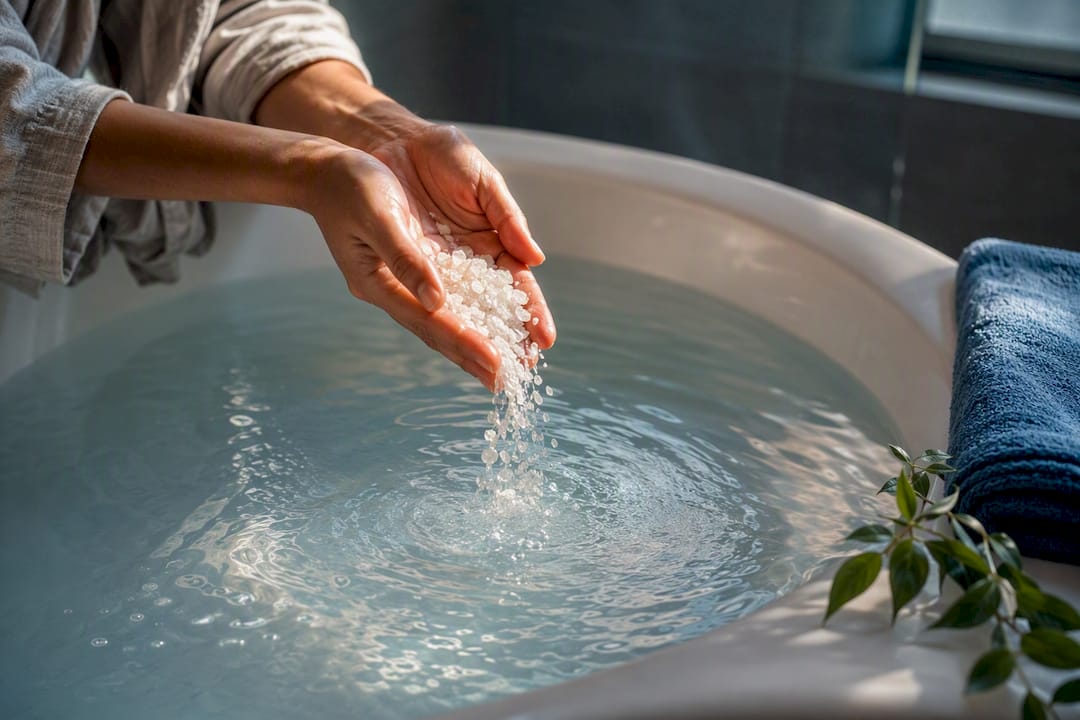
Aura cleansing is the practice of clearing the energy field said to surround your body of stress, fatigue and residue picked up from other people or environments. Try this: breathe in for four counts imagining light gathering around you, hold for two, then exhale for six as you picture anything heavy leaving your body through your feet. Do that three times. That’s a working aura cleanse, and you’ve already done one.
TL;DR:
Regular aura cleansing can improve mental clarity, emotional stability, and self-connection, especially after stressful experiences or being in crowds.
Salt baths, breath exercises, sound, and grounding are among the most accessible and effective methods for clearing energy residue.
Consistent short practices, such as two to five minutes daily or weekly, often yield better results than infrequent deep rituals.
Caution is necessary with practices like salt baths and smoke clearing to avoid skin irritation and respiratory issues, and persistent low mood requires professional support.
Aura cleansing techniques complement other holistic practices like chakra work, meditation, and movement, serving as preparation and integration for deeper healing.
Table of Contents
Why cleanse your aura, and how do you know you need one?
You reach for an aura cleanse the same way you’d reach for a shower after a long day, except the residue you’re clearing isn’t visible. The most common trigger is a flat, foggy tiredness that sleep doesn’t fix, especially after time in crowds, hospitals, or a difficult conversation.
Other signals people report are surprisingly consistent across different traditions and practitioners:
Feeling emotionally “off” without a clear cause, as if you’ve absorbed someone else’s mood
Mental fog or scattered focus that lifts once you’re alone and quiet
Heightened sensitivity to noise, light or other people’s energy after stressful events
A sense of being weighed down, ungrounded, or disconnected from your own body
The reported benefits of regular practice include better mental clarity, stronger self-connection, and steadier emotional balance. There’s a physiological thread worth knowing too: breathwork and grounding exercises activate the body’s relaxation response, which may explain why so many people describe feeling lighter after a session even before you factor in anything more esoteric.
Pro Tip: If you can’t tell whether what you’re feeling is “your” energy or something you’ve picked up, ask yourself if the mood arrived suddenly after being around a specific person or place. That timing is often the clearest clue.
What are the best aura cleansing methods to try?
Methods for energy clearing group naturally by element, and most people find two or three that suit their life rather than trying all of them.
Water: salt baths and scrubs. Dissolve two cups of sea salt, Epsom salt or Himalayan salt into a warm bath and soak for fifteen minutes, checking first for skin sensitivities and avoiding open wounds. No bath at home? Mix a tablespoon of salt with your regular shower gel and use it as a scrub, picturing tension rinsing away with the water.
Breath and visualisation. The three-breath reset from the opening of this article works anywhere: in a car park, before a meeting, at your desk. For something deeper, try alternate nostril breathing for two minutes, which many people find settles racing thoughts faster than a straight breath count.
Smoke and space clearing. Traditional smudging has indigenous cultural origins that deserve respect rather than casual borrowing. If you want a smoke-based practice, look for ethically sourced alternatives, always ventilate the room, and ask before clearing a shared space. A beeswax candle or a diffused cleansing spray works just as well if smoke isn’t practical.
Sound. Clapping firmly around the edges of a room, ringing a small bell, or simply humming for thirty seconds shifts the feel of a space almost instantly, and it costs nothing.
Crystals. Selenite is popular precisely because it’s said to need no cleansing itself. Clear quartz is the generalist’s choice: hold it during a breathing practice, then leave it on a windowsill overnight once a week to recharge.
Grounding in nature. Ten minutes barefoot on grass, or a slow walk under trees, does double duty as both a grounding technique and a short stretch of genuine rest.
Choose one method based on time and setting, not on trying to do everything at once.
State a one-sentence intention before you start. Something as simple as “I release what isn’t mine” sharpens focus and improves how effective the practice feels.
Practise for a few minutes, then notice how your body feels differently at the end versus the start.
A guided aura cleansing meditation you can follow now
This follows the standard structure most guided aura meditations use: ground, scan, cleanse, seal. Sit or lie somewhere quiet, feet flat on the floor or hands resting on your lap.
0:00 to 2:00, ground. Feel your feet or your seat against the surface beneath you. Take three slow breaths, letting your shoulders drop on each exhale.
2:00 to 6:00, scan. Move your attention slowly from your head to your feet, noticing any area that feels tight, heavy or unusually quiet. Don’t try to fix anything yet, just notice.
6:00 to 10:00, cleanse. Picture a soft light, any colour that feels calming, filling the space around your body. With each exhale, imagine it sweeping outward through your skin, carrying tension with it.
10:00 to 12:00, seal. Picture that light settling into a thin, steady layer around you. Take one final breath and mentally say “sealed” or “complete.”
Short on time? A three to five minute version works: skip straight to the light visualisation for two minutes, then seal for one. If a wave of emotion feels too intense at any point, open your eyes, plant both feet firmly, and stop. That’s a sign to rest, not to push through.
How often should you cleanse your aura?
Daily micro-cleans matter more than occasional deep sessions. A short, consistent two to five minute practice most days outperforms an intense ritual done once a month.
Daily: the three-breath reset, or thirty seconds of humming before bed.
Weekly: a full salt bath, the ten to fourteen minute guided meditation, or a proper grounding walk.
Starter plan: pick one two-minute morning practice and one weekly deeper session, then track for seven days before adding anything else.
Safety, boundaries and when to get professional support
A few practical cautions matter more than most guides admit. Salt baths can irritate broken skin, smoke practices can trigger respiratory issues, and essential oils need patch-testing before wider use.
Ventilate any room where you’re burning herbs, and never leave smoke unattended.
Build a simple boundary by picturing a thin shield of light around your body each morning, which pairs well with the empath protection techniques many sensitive people rely on daily.
If low mood, anxiety or fatigue persists beyond a few weeks, that’s a signal to speak with a doctor, therapist, or an experienced energy-healing practitioner rather than relying on self-practice alone.
Where does aura cleansing actually come from?
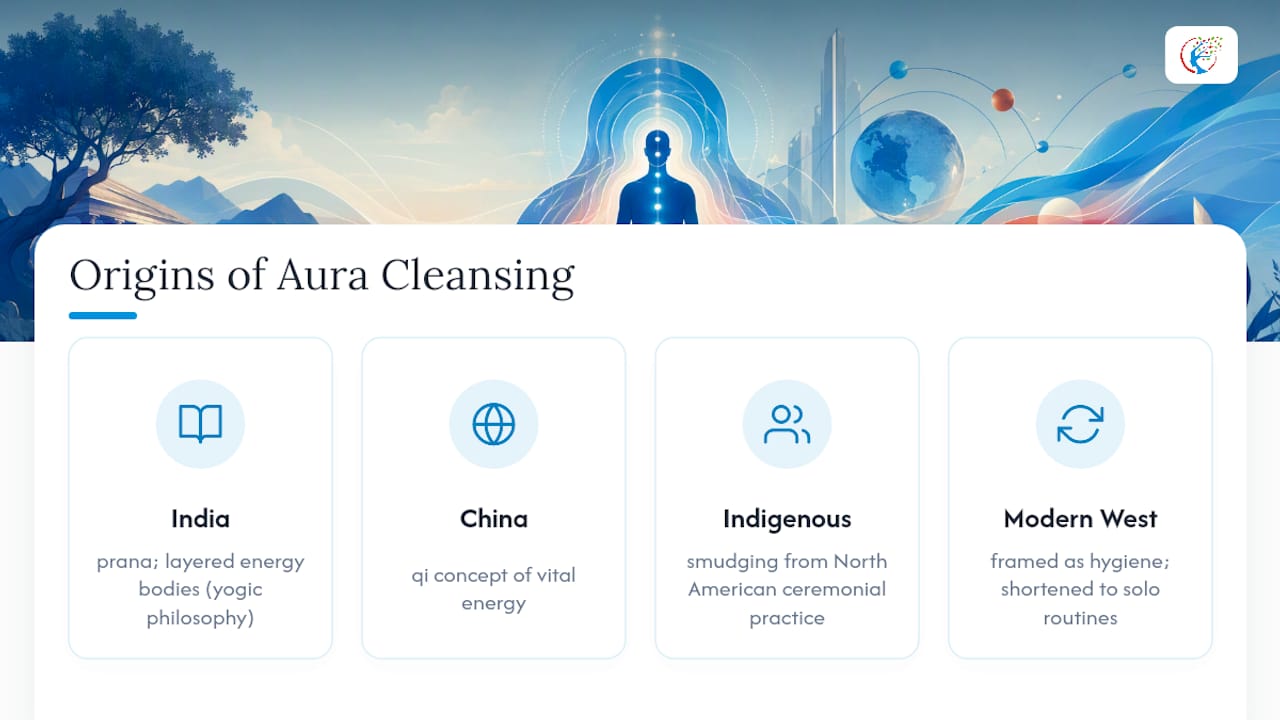
The idea that the body carries a field of energy worth tending isn’t a modern wellness invention. Traditions across India, China and Indigenous cultures in the Americas have described something similar for centuries, from prana and qi to the layered energy bodies described in yogic philosophy.
Sadhguru, a widely followed contemporary teacher, frames aura cleansing as analogous to physical hygiene: just as you wash your body daily, the energetic field benefits from regular attention, using elemental metaphors of water, wind and fire as purifying forces. That framing has stuck because it maps neatly onto something everyone already understands: neglect builds residue, and residue eventually shows.
Smudging, one of the most recognisable modern aura cleansing tools, comes specifically from Indigenous North American ceremonial practice, and its popularity in Western wellness circles has drawn fair criticism for stripping the ritual of its cultural context. Salt-based purification appears independently in Japanese Shinto practice, in Jewish tradition, and in old European folk customs, suggesting the underlying instinct, that certain substances clear something unseen, arose in multiple places without any single origin point.
What’s changed isn’t the core idea. It’s the packaging: a practice once embedded in community ceremony and lineage has been distilled into five-minute solo routines for a generation short on time but not on stress.
Is aura cleansing just placebo, and does it actually work?
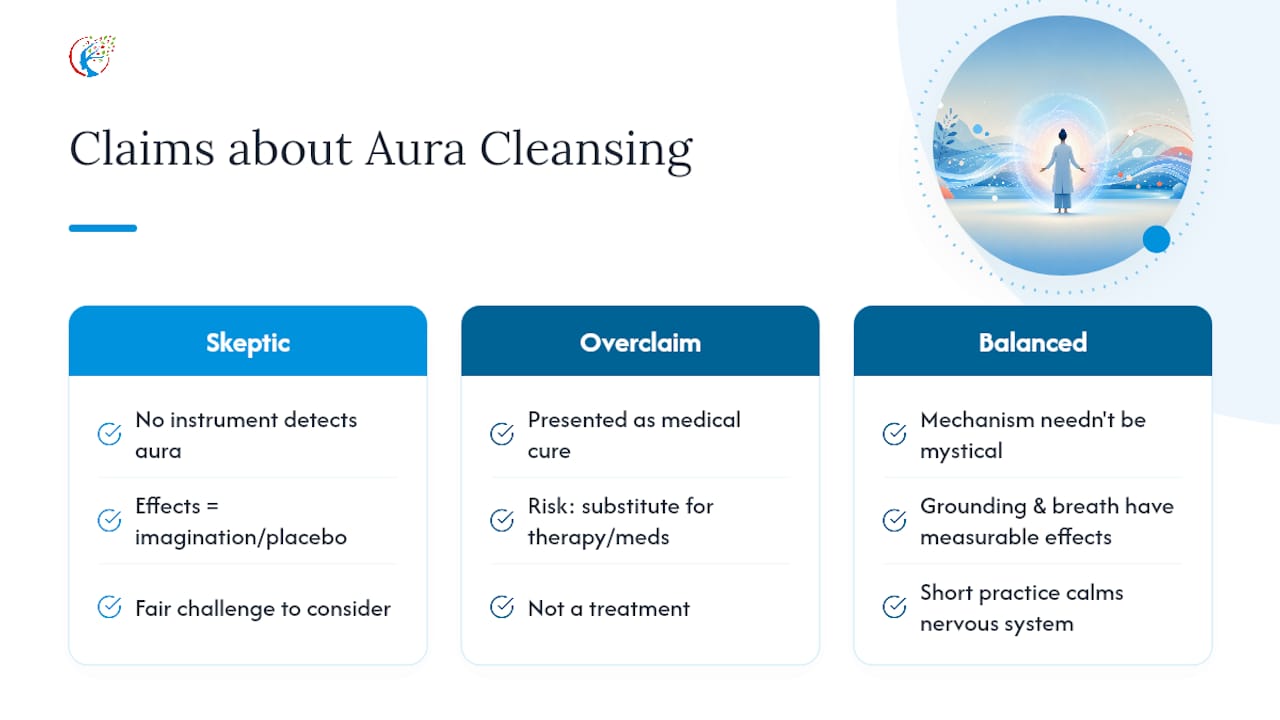
The most common skeptical argument is straightforward: there’s no instrument that measures an aura, so any reported effect must be imagination or placebo. That’s a fair challenge, and it’s worth taking seriously rather than dismissing.
What the skeptics often miss is that the mechanism doesn’t need to be mystical for the practice to be genuinely useful. Grounding and breathwork produce measurable physiological effects, activating the body’s relaxation response in ways that are well documented outside any spiritual framework. Slowing your breath, focusing attention on your body, and setting a clear intention are all things that calm the nervous system regardless of whether you believe in energy fields.
The reverse misconception is just as common: some practitioners present aura cleansing as a cure for conditions that need medical or psychological treatment. It isn’t one, and treating a breathing exercise as a substitute for therapy or medication for a diagnosed condition is a real risk, not a minor caveat.
The honest position sits between the two extremes. You don’t need to believe in a literal energy field to benefit from five minutes of deliberate, focused breathing and reflection. Whether you call that “clearing your aura” or “resetting your nervous system” matters less than doing it consistently.
How do you combine aura cleansing with other holistic practices?
Aura cleansing rarely works best in isolation. It tends to sit most naturally alongside chakra balance work, since a blocked or overactive chakra is often described as the specific location where stagnant energy shows up, and a general aura sweep followed by targeted root chakra grounding covers both the broad field and the specific pressure point.
Meditation and aura cleansing overlap so heavily that many people are already doing both without separating them. A daily mindfulness sit becomes a cleansing practice the moment you add an intention and a closing seal.
Journalling afterwards adds a layer most people skip. Writing down what came up during a scan, which body part felt heavy, what emotion surfaced, turns a vague sense of “feeling lighter” into a pattern you can track over weeks.
Movement matters too. Yoga, tai chi or even a brisk walk primes the body to release tension physically before you attempt to address it energetically, and grounding in nature works better after movement than before it. The order isn’t rigid, but starting with the body and finishing with stillness tends to produce a more noticeable shift than the reverse.
How aura cleansing fits into deeper healing work
In sessions, cleansing techniques often serve as preparation, settling a client’s nervous system before deeper subconscious work begins, and as integration, helping someone ground what surfaced once a session ends. A client who arrives scattered rarely accesses much; a few minutes of breath and grounding first changes that. These aren’t separate from energy healing work; they’re often the doorway into it.
— Paul
Ready to go deeper than a five-minute self-practice?
If the techniques above helped you feel lighter, that’s exactly the starting point for the work Paulstebles does professionally, just with far more depth and a trained hand guiding the process. Where a solo salt bath or breathing script can shift how you feel for an afternoon, a guided energy healing session combining Reiki, chakra balancing and cord cutting works with blockages that self-practice alone rarely reaches, whether that’s a recurring emotional pattern, unexplained physical tension, or a sense of stagnation that doesn’t lift no matter how often you cleanse.
For anyone wanting to go further still, Quantum Healing Hypnosis sessions access the subconscious mind directly, often surfacing the root of an issue that surface-level energy work only manages. Sessions run in-person and remotely, so location isn’t a barrier. First appointments typically involve a conversation about what’s bringing you in before any hypnosis begins, so you’ll know what to expect before you commit. If you’re weighing up whether it’s right for you, the QHHT FAQ answers the questions most people ask first, and booking a session takes a few minutes on the calendar.
Sources
For further reading on the practices covered here: Mindbodygreen’s expert guide to aura cleansing, Ashleigh Grange’s energy cleansing methods, Yoga Journal on energy healer practices, and Insight Timer’s guided meditation structure. For wellness aftercare more broadly, NexGen Clinic’s wellness journal is a useful resource.
FAQ
How can I cleanse my aura?
Start with a breath and visualisation practice, three slow breaths while picturing light clearing away tension, then build up to salt baths, grounding walks or a full guided meditation as you find what suits you.
How do you know if your aura is clean?
Most people describe feeling lighter, calmer and more like themselves, with clearer focus and less of the emotional “static” that comes from absorbing other people’s moods.
What does it mean to cleanse your aura?
It means using a deliberate practice, breath, salt water, sound or grounding, to clear stress and residue from the energy field said to surround your body, restoring a sense of balance and clarity.
How do you cleanse your aura with salt?
Dissolve around two cups of sea salt, Epsom salt or Himalayan salt into a warm bath and soak for fifteen minutes, checking first for skin sensitivities, or use a tablespoon mixed into shower gel as a scrub alternative.
Recommended
Comments