Nervous system reset: QHHT and energy healing explained


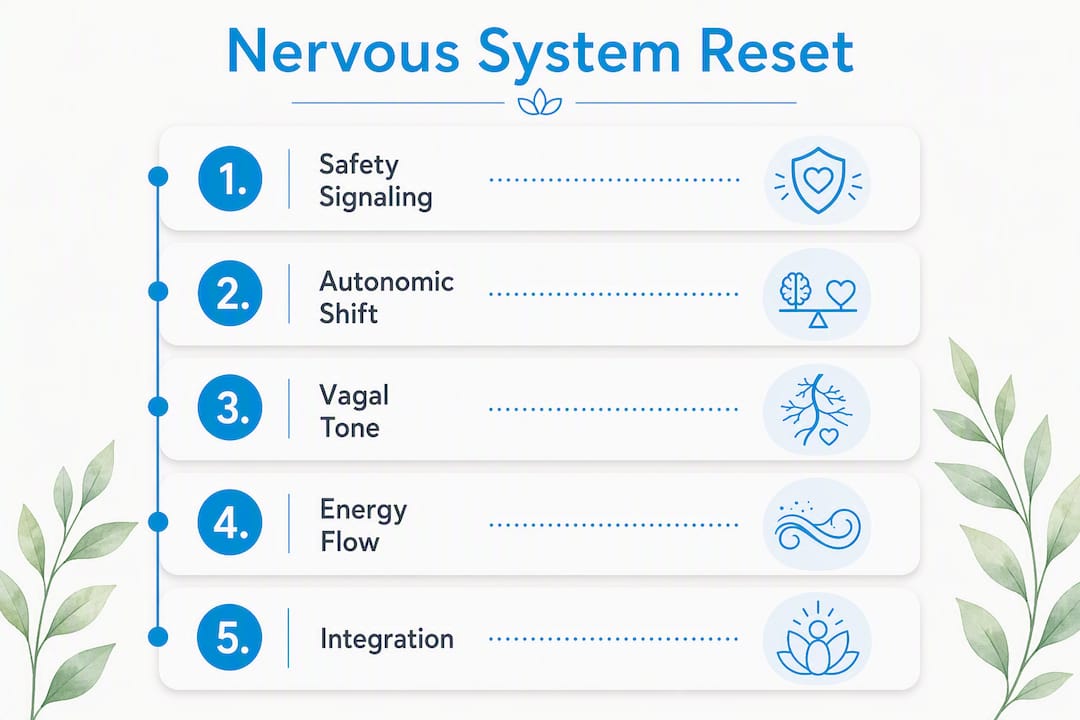
A nervous system reset, in the context of QHHT and energy healing, is the physiological and experiential downshift that occurs when subconscious regression work and energetic interventions create enough safety signalling for the autonomic nervous system to move out of chronic sympathetic arousal and into parasympathetic restoration. This is not a metaphor. Practitioners and clients report measurable shifts: increased heart-rate variability, slower breathing, reduced muscle tension, and a quieting of the mental noise that accompanies chronic stress. Some of these changes are noticeable during the session itself; most continue to unfold over the days and weeks that follow.
If you are ready to explore whether a session is right for you, the clearest next step is to book a QHHT session with Paulstebles or browse the services overview at paulstebles.com.
Signs clients commonly notice after a session:
A measurable or subjective increase in heart-rate variability
Slower, fuller breathing without deliberate effort
Reduced muscular tension, particularly in the jaw, shoulders, and chest
Improved sleep quality in the first 48–72 hours
A sense of emotional spaciousness or reduced reactivity
Table of Contents
How does QHHT actually shift the nervous system?
The core mechanism is safety signalling. When the body receives consistent cues that it is not under threat, the autonomic nervous system stops prioritising sympathetic activation and allows parasympathetic pathways to take over. Energy healing sessions facilitate exactly this shift, moving the system from arousal toward restoration, with reported effects including reduced inflammation, lower muscular tension, and increased heart-rate variability.

QHHT adds a specific architecture to this process. The session moves through induction into a deep trance state, contact with the Higher Self, regression to scenes that carry emotional or physical significance, and then a body scan in which the Higher Self identifies energetic imbalances. This Higher Self scan can surface insight into root causes of symptoms that have resisted conventional explanation, and that insight itself often produces a rapid energetic shift. Understanding why a pattern exists is frequently what allows the nervous system to stop defending it.
Measurable markers practitioners reference to include:
Heart-rate variability (HRV): a widely used indicator of vagal tone and autonomic flexibility
Breathing rate: slowing naturally as trance deepens and the parasympathetic system activates
Brainwave activity: shifting toward alpha and theta states during deep hypnotic induction
Muscle tension: releasing progressively through the session, often without any direct instruction
Research mapping energy healing outcomes points to HRV increases as a consistent marker of improved vagal tone during and after sessions. Polyvagal cues from the practitioner, tone of voice, pacing, and grounded presence, also matter. The practitioner’s own regulated state communicates safety non-verbally, which is why the quality of the therapeutic relationship is not incidental to the outcome.
What happens during a QHHT session, step by step?
The flow runs: intake and intention-setting, induction into trance, Higher Self contact and regression, energetic interventions and body scan, then debrief and aftercare planning. A full session typically runs three to five hours, though the active healing work occupies a smaller portion of that time.
Intake (30–60 minutes). You discuss your intentions, the questions you want to bring to your Higher Self, and any relevant health or emotional history. Consent is established here, including what kinds of energetic work you are comfortable with and how you would like the practitioner to handle any distress that arises.
Induction and trance (20–40 minutes). A guided relaxation deepens progressively until you reach the somnambulistic state QHHT requires. Breathing slows, muscle tension releases, and brainwave activity shifts toward theta.
Higher Self contact and regression (60–90 minutes). The practitioner guides you to scenes, past-life or present-life, that your Higher Self identifies as relevant. Insight and emotional resolution often occur here. QHHT’s regression structure is designed to let the subconscious present what is most needed rather than what the conscious mind expects.
Energetic interventions and body scan (20–40 minutes). The Higher Self scans the physical body for imbalances. Healing, whether emotional, physical, or energetic, may be offered where the Higher Self considers it appropriate. Techniques such as Reiki, cord cutting, chakra balancing, and timeline healing may be woven in.
Debrief and aftercare plan (20–30 minutes). You return to full waking awareness, review what arose, and receive specific aftercare guidance. A recording of the session is typically provided.
In-person versus remote sessions
In-person sessions take place at a dedicated space where the physical environment supports deep relaxation. Remote sessions follow the same structural sequence; practitioners conducting distance work use intention, clear structure, and client attunement to replicate the safety conditions of an in-person setting. Client reports from remote sessions consistently describe similar subjective downshifts. For remote work, you will need a quiet room, a comfortable reclining position, headphones, and a stable video connection.
Bring to any session: a list of questions for your Higher Self, a light meal beforehand (not immediately before), comfortable clothing, and any relevant medical or medication information for the intake discussion.
Who is this suitable for, and when should you seek medical support?
QHHT and energy healing are suited to people seeking deep emotional, spiritual, or physical healing who are willing to engage with trance work and energetic integration. That covers a wide range, from those carrying long-standing grief or anxiety to those with physical symptoms that have no clear conventional explanation, or those simply wanting to understand their life’s direction more clearly.
Clear contraindications and cautionary cases include:
Unmanaged psychosis or active delusions: trance work can intensify dissociation and is not appropriate without psychiatric clearance
Severe psychiatric instability: where medication is being actively adjusted or crisis support is in place, defer until stable
Acute medical emergencies: sessions are not a substitute for urgent medical care
Certain neurological conditions: discuss with your GP before booking if you have epilepsy or a related condition
Sessions sit alongside medical and psychiatric care, not in place of it. Practitioners handle risk through thorough intake, grounding techniques if distress arises mid-session, pacing that follows the client’s readiness, and clear emergency protocols.
Pro Tip: Disclose all medications and your full mental-health history during intake, including anything you consider minor. Certain medications affect trance depth, and a practitioner who knows your full picture can adjust their approach accordingly.
How to prepare, and what to do in the days after
Simple, intentional preparation genuinely improves outcomes. Arriving with a clear intention and a short list of questions for your Higher Self gives the session focus and helps the subconscious know what territory to explore.
Pre-session checklist:
Sleep well the night before; fatigue reduces trance depth
Hydrate normally but avoid alcohol for at least 24 hours beforehand
Write a list of around ten questions you want to bring to your Higher Self, covering emotional, physical, and life-direction themes
Eat a light meal two to three hours before the session
Arrange transport so you are not driving immediately after (some clients feel deeply relaxed or emotionally open post-session)
Confirm consent boundaries and any concerns with the practitioner before the day
Preparing questions for the Higher Self and reflecting on life themes in the days beforehand consistently improves session focus and depth.
Integration timeline:
First 72 hours: rest as much as possible, journal what arose in the session, drink plenty of water, and avoid heavy social commitments. The nervous system is actively reorganising.
Days 4–14: small consistent practices such as slow breathing, quiet reflection, and gentle movement support the gradual retraining that follows a session. Notice what has shifted rather than looking for dramatic proof.
Ongoing: journalling, gentle embodiment practices, and simple HRV tracking (a wearable such as a Garmin or Polar device gives a useful baseline) help you observe changes over weeks. Schedule a follow-up session when you feel the integration has plateaued or new questions have emerged.
Practitioners consistently note that the most profound changes unfold over days and weeks, not only during the appointment itself.
What evidence exists, and how do you verify a practitioner?
Evidence in this field is mixed, as it is across most complementary modalities, but the measurable markers are meaningful. HRV increases, EEG shifts, and subjective reports of calm and improved sleep are documented across multiple practitioner accounts and some formal studies. Energy healing practices such as Reiki and guided intention consistently support parasympathetic activation and subjective relaxation, even among clients who arrive sceptical.
Client testimonials are a meaningful signal when they are specific: they describe what changed, over what timeframe, and in what area of life. Generic praise tells you little. Ask a prospective practitioner whether they can share outcome examples or connect you with a previous client willing to speak.
Credentials checklist:
Verified QHHT training (Level 1 minimum; Level 2 or BQH for remote sessions)
Energy-healing qualifications (Reiki attunement level, additional modality training)
Transparent session policies: consent process, recording policy, cancellation terms
Specific, named client testimonials rather than anonymous five-star ratings
Willingness to discuss contraindications and refer out when appropriate
Paulstebles: QHHT, energy healing and the anxiety course
Paulstebles offers in-person and remote QHHT with integrated energy healing, serving clients across the UK. Sessions combine regression hypnotherapy with modalities including Reiki, chakra balancing, cord cutting, timeline healing, and belief transformation, giving each session a depth that standalone hypnotherapy rarely reaches.
Available services include standard in-person QHHT sessions, mobile QHHT for clients who prefer a home visit, remote energy healing sessions, and individual in-person energy healing appointments. For those dealing specifically with anxiety or depression, the structured online course, available via Udemy, provides video content and exercises that work as a standalone programme or as integration support between sessions.
Fees are not publicly listed; contact Paulstebles directly for current pricing. New clients can book through the website calendar or enquire via the contact page. First contact typically involves a brief conversation to confirm suitability before a session date is confirmed.
To take the next step, view the QHHT FAQ for detailed method information, or book directly through the session pages above.
Key takeaways
A nervous system reset via QHHT and energy healing works by creating sustained safety signals that shift autonomic balance toward parasympathetic restoration, with changes that often continue well beyond the session itself.
Point | Details |
What “reset” means here | A shift from sympathetic arousal to parasympathetic restoration, produced by QHHT regression and energetic interventions. |
Measurable markers | Increased HRV, slower breathing, reduced muscle tension, and improved sleep are the most commonly reported indicators. |
Who it suits | Those seeking deep emotional, spiritual, or physical healing who are ready to engage with trance work; not suitable during unmanaged psychosis or acute medical crisis. |
Preparation matters | Writing ten questions for the Higher Self and reflecting on life themes beforehand consistently improves session focus and depth. |
Paulstebles sessions | In-person and remote QHHT with integrated energy healing, plus an online anxiety/depression course; book via paulstebles.com. |
What a reset actually feels like in practice
Most people expect a dramatic moment. What actually happens is quieter and, in my experience, more lasting. The shift tends to announce itself not during the session but the morning after, when someone wakes up and notices that the background hum of anxiety is simply lower. Not gone, necessarily, but lower. That is the nervous system having had permission, perhaps for the first time in years, to stop bracing.
What I pay attention to is not the emotional release during the session, though that matters. It is what the client notices in the two weeks that follow: sleep quality, reactivity to ordinary stressors, the ease or difficulty of sitting quietly. Those are the real indicators of whether the autonomic system has genuinely reorganised or whether the session produced a pleasant but temporary relaxation response.
Pacing matters more than most clients expect. One session can open a door; integration is what you walk through it. If you are curious about whether this approach fits your situation, the most useful thing is a conversation before you commit to a booking.
Further reading and useful resources
What actually happens in a typical QHHT session — Hypnotherapy Directory: practitioner-level walkthrough of session structure and the Higher Self scan
About QHHT — Dolores Cannon: the original method description, regression structure, and Higher Self contact
Exploring the neuroscience behind energy healing — Susana DuMett: mechanisms, safety signalling, and measurable markers
QHHT guide — Bodhi Holistic Hub: preparation, integration, and pacing advice
Energy healing and nervous system support — Silent Medicine: parasympathetic activation and what clients commonly experience
Energy healing and HRV — Kolleqtive: measurable outcomes including HRV and EEG markers
Paulstebles QHHT service page — session outcomes, format, and booking
Energy healing FAQ — Paulstebles: common client questions and aftercare guidance
Paulstebles blog — practitioner perspectives and client stories
This article is general information, not medical or psychiatric advice. If you have an active mental-health condition or are under medical supervision, consult your GP or specialist before booking a session.
Recommended
Comments