UK clinician: 5 questions to spot spiritual causes of anxiety


Yes, spiritual struggle can contribute to anxiety, but it rarely acts alone. Research linking negative religious coping to higher anxiety symptoms sits alongside clinical evidence, including a hypnosis meta-analysis showing measurable benefit when paired with therapy and not used in isolation. What follows explains the common spiritual causes, the symptoms that overlap with clinical anxiety, and the safest ways to get help.
TL;DR:
Spiritual anxiety often involves feelings of disconnection, guilt, or existential dread, which can intensify physical symptoms like panic or sleep disturbances.
Negative religious coping and spiritual decline are linked to greater psychological distress and increased anxiety symptoms, especially in serious illness contexts.
Combining medical assessments, psychological therapies, and spiritually attuned practices yields the most effective treatment for anxiety with spiritual elements.
Hypnosis is most effective when integrated with other psychological interventions, and practitioners should clarify their scope, qualifications, and collaboration with healthcare providers.
Safety concerns, such as thoughts of self-harm or rapid worsening, require immediate medical contact before exploring spiritual explanations or alternative treatments.
Table of Contents
Common spiritual explanations for anxiety
Anxiety with a spiritual flavour tends to fall into a handful of recognisable patterns. None of these are diagnoses. They’re frameworks people reach for when their fear feels bigger than “just stress.”
Psychologists sometimes use the phrase sacred anxiety to describe fear that carries existential weight. Facing mortality, questioning your purpose, or sensing the vastness of something beyond yourself can produce a specific kind of dread that feels different from ordinary worry. It’s discussed as an emblem of spiritual awareness rather than a malfunction, an experience woven into contemplative traditions for centuries, according to writing on sacred anxiety and its cultural framing.
Then there’s negative religious coping: feeling abandoned by God, believing anxiety is divine punishment, or wrestling with moral conflict that won’t resolve. This pattern shows up often enough in psychiatric outpatient populations that clinicians treat it as a distinct source of distress, with negative religious coping consistently tied to greater psychological distress.
A smaller but real group of people experience something closer to spiritual trauma. This includes scrupulosity (sometimes called religious OCD, marked by intrusive guilt over perceived sin) and, for some, a genuine fear of demonic attack. The evidence here is thinner and more contested than for general religious struggle, so treat these as personally meaningful explanatory models rather than settled fact.
Finally, many people describe anxiety in energetic terms: ungrounded energy, blocked chakras, or a sense of being spiritually “unmoored.” These explanations resonate because they give shape to something that otherwise feels formless, and for some people they open a route into practices that genuinely calm the nervous system.
What ties these together:
Sacred anxiety: existential fear tied to mortality, meaning, or awe
Negative religious coping: feeling punished, abandoned, or morally conflicted
Spiritual trauma or scrupulosity: guilt-driven anxiety rooted in religious upbringing or belief systems
Energetic explanations: a felt sense of imbalance, often described through chakras or energy flow
None of these frameworks should be read as proof of supernatural causation. They’re lenses people use to make sense of distress, and the right lens is the one that helps you understand your own experience without dismissing what a GP or therapist might also need to assess.
How does spiritual anxiety feel and behave?
Spiritual-style anxiety often announces itself through experience before it shows up as a clinical symptom. People describe a rising, restless energy that won’t settle, a sense of disconnection from their own intuition, or a feeling of being abandoned by whatever they consider divine. Moral rumination, turning over the same guilt or doubt for hours, is another common thread, particularly for anyone raised in a strict religious environment.
The tricky part is the overlap with textbook anxiety symptoms. Panic, breath-holding, a racing heart, disrupted sleep: these are the same physical markers you’d see in generalised anxiety disorder, regardless of whether the trigger feels spiritual or situational. Spiritual distress doesn’t sit apart from the body; it often intensifies whatever the nervous system is already doing.
Practices meant to bring peace can sometimes backfire. Meditation that encourages sustained inward attention can intensify rumination in people already prone to anxious thought loops, an effect noted in research on how nonreligious spiritual practices interact with anxiety. Religious rituals meant to atone or cleanse can, for someone with scrupulosity, become a trigger rather than a relief.
A short self-check can help you work out what you’re dealing with:
Does the anxious feeling attach to a specific spiritual question (meaning, punishment, disconnection) or does it float without a clear cause?
Has a spiritual practice you once found calming started making you feel worse?
Are you experiencing physical symptoms, panic, insomnia, breathlessness, alongside the spiritual distress?
Has this lasted more than a few weeks, or is it interfering with daily function?
Do you feel safe, or does the fear include thoughts of harm to yourself or others?
Pro Tip: If question 5 raises any concern at all, contact a GP or call 111 before exploring spiritual explanations further. Spiritual frameworks can wait; safety cannot.
If your answers point to a spiritual root, the sleep paralysis spiritual meaning guide shows how spiritual and medical explanations can sit side by side without cancelling each other out.
Why do spiritual struggles raise anxiety alongside biology?
Spiritual decline and biological stress responses feed each other, and treating them as separate problems usually misses the point. Anxiety linked to spiritual struggle rarely stays contained to the spiritual domain. It leans on the same nervous system, the same stress hormones, and often the same trauma history as anxiety with no spiritual dimension at all.
The clearest evidence comes from patients dealing with serious illness. People with more past negative religious experiences reported more anxiety symptoms, while those with stronger current spiritual well-being reported fewer, according to a study on spiritual history and wellbeing in serious illness. That’s not a small correlation buried in a niche journal. It’s a pattern robust enough to show up across a clinical population under real strain.
Spiritual growth can mediate certain struggles toward greater wellbeing, while spiritual decline mediates the effect of demonic, moral, and interpersonal struggle on increased anxiety.
That distinction, drawn from research on religious and spiritual struggles and meaning-making, matters because it points to a mechanism, not just an association. When someone’s spiritual framework is deteriorating, when they feel abandoned, morally compromised, or cut off from a community that once gave them meaning, rumination increases and a coherent sense of meaning falls away. That loss of coherence appears to be what drives anxiety upward, rather than spirituality itself being the culprit.
Biology never sits this out. Anxiety involves real physiological machinery: the HPA axis, cortisol regulation, the autonomic nervous system’s fight-or-flight circuitry. Chronic psychosocial stress, spiritual or otherwise, keeps that machinery switched on, and prolonged activation is implicated in wider health risks, including cardiovascular strain, according to research on anxiety, psychosocial stress, and integrated care. Someone with a trauma history or an underlying anxiety disorder is also more likely to interpret ambiguous spiritual experiences (a strange dream, an intense meditation session) through a fearful lens, which can deepen both the spiritual and the biological symptoms at once.
It’s worth adding a note of nuance here: spirituality’s relationship with anxiety is less consistent than its relationship with depression. Spiritual and religious practices show a more reliable protective effect against depressive symptoms, whereas the link with anxiety varies considerably depending on how that spirituality is practised and how coherent it feels to the person living it, per the same Nature-published study. A structured, community-supported faith practice tends to look different, statistically, from a solitary, uncertain one.
The practical takeaway is straightforward even if the mechanism is layered: anxiety with a spiritual dimension responds best to combined care. A medical assessment to rule out or manage underlying physiological drivers, a psychological approach such as CBT or trauma-focused therapy for the thought patterns, and space for spiritually attuned reflection to address the meaning-making side. Leaving any one of those out tends to leave part of the problem untouched. The depression and spiritual healing guide covers how this plays out when spiritual decline shows up as low mood rather than anxious energy.
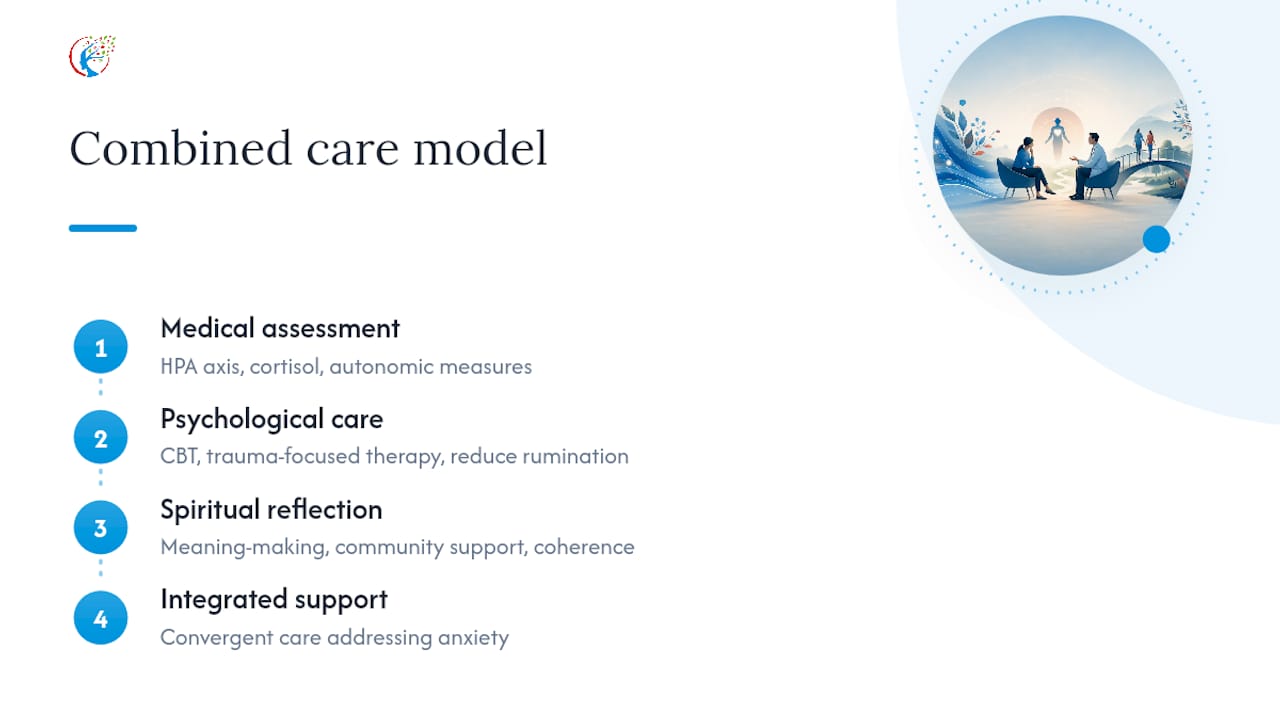
What treatment options combine spiritual work with clinical care?
Hypnosis works best as one tool among several, not a stand-alone fix. A meta-analysis of hypnosis trials found a mean weighted effect size of 0.79 at the end of treatment, rising to 0.99 at the longest follow-up point, with hypnosis outperforming control conditions and showing the strongest results when combined with other psychological interventions. That’s a meaningful effect, but the detail that matters most is the word “combined.” The American Psychological Association’s own guidance on hypnotherapy frames it the same way: hypnosis is most useful as a way of accessing subconscious material that then gets worked through in ordinary therapeutic dialogue.
Mayo Clinic’s consumer guidance echoes this. Hypnosis can genuinely ease procedural anxiety and certain phobias, but for anxiety rooted in historical trauma, clinicians typically favour approaches like CBT alongside or ahead of hypnotic work. That’s not a knock against hypnosis; it’s a sensible division of labour.
This is where regression hypnotherapy, energy healing, and conventional psychotherapy can fit together without stepping on each other’s toes. Regression work can surface material, a memory, a belief, a moment of disconnection, that a client hadn’t consciously connected to their anxiety. Energy healing (Reiki, chakra balancing, cord cutting) often supports the nervous-system settling that makes that material easier to sit with. Psychotherapy or GP-led care handles diagnosis, medication where appropriate, and structured symptom management. None of these should be asked to do the other’s job.
If you’re weighing up practitioners, a few questions are worth asking before you book anything:
What are their actual qualifications, and what’s their scope of practice?
Do they carry professional insurance, and do they have a referral pathway to GPs or mental-health services?
Do they screen for red flags, active suicidal ideation, psychosis, untreated severe trauma, before offering regression or energy work?
Are they transparent that spiritual approaches support rather than replace medical assessment?
A typical session pathway with an integrative practitioner usually starts with an intake conversation covering your history and current symptoms, moves through basic safety checks, and stays open to coordinating with your GP or existing mental-health team where needed. That coordination matters. The performance anxiety and hypnosis piece walks through how this looks in a specific, lower-stakes context if you want a concrete example before considering deeper regression work.
Pro Tip: Ask any practitioner directly how they’d handle it if a session surfaced something beyond their scope. A clear, honest answer tells you more about their competence than any testimonial could.
How I think about spiritual anxiety in practice
I don’t treat spiritual explanations and clinical ones as competing stories. Someone arrives describing a feeling of disconnection or abandonment, and my first job is to help their nervous system settle enough that we can actually work with whatever meaning they’re making of that feeling. Regulation comes before interpretation. You can’t do meaningful exploration of a spiritual experience while someone’s system is locked in fight-or-flight.
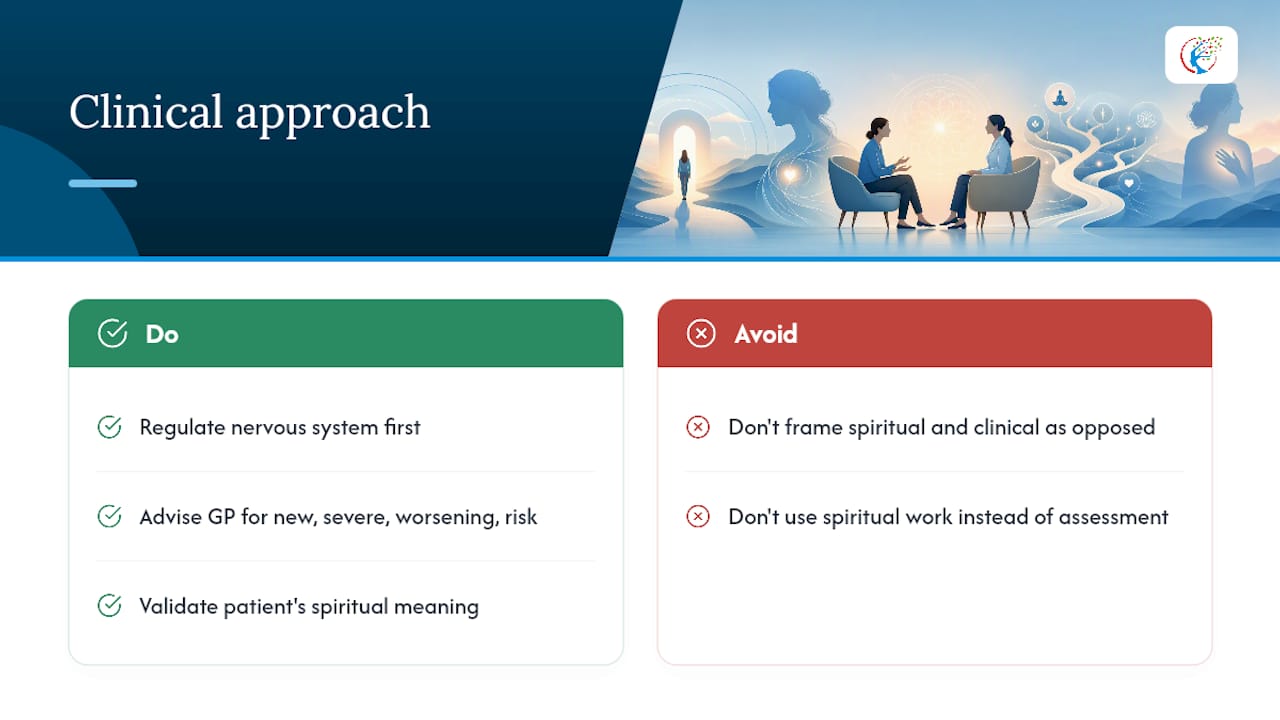
I’ll always suggest a GP conversation, or recommend it runs alongside our work, when anxiety is new, severe, worsening quickly, or involves any risk to safety. Spiritual work is not a substitute for that assessment. It’s a companion to it.
What I try hardest to hold onto is respect for the experience itself. Someone’s sense that their anxiety means something, that it’s connected to purpose, faith, or a spiritual shift, deserves to be taken seriously rather than explained away. Validating that doesn’t mean abandoning caution. It means doing both at once.
— Paul
Sources
The clinical claims here draw on peer-reviewed work linking spiritual well-being and anxiety in serious illness, research on meaning-making and spiritual struggle, and a meta-analysis of hypnosis for anxiety, alongside consumer-facing clinical guidance from Mayo Clinic on hypnosis. For readers assessing practitioners more broadly, this comparison of spiritual assessment practices offers useful background on how professionals approach spiritual history-taking.
If you’re considering an integrative route yourself, the QHHT FAQ page explains what a session with Paul Stebles typically involves, from intake through to what clients can expect afterwards.
FAQ
What is the spiritual root cause of anxiety?
There isn’t one single root cause, but common explanations include negative religious coping (feeling punished or abandoned), spiritual decline or loss of meaning, and existential “sacred anxiety” tied to mortality or purpose. These framings usually sit alongside biological and psychological factors rather than replacing them.
What are some spiritual symptoms of anxiety?
People often describe rising, restless energy, a sense of disconnection from their own intuition, feeling abandoned by the divine, or persistent moral rumination. These frequently overlap with physical symptoms like panic, breath-holding, and disrupted sleep.
What helps to calm anxiety with a spiritual dimension?
A combined approach tends to work best: medical assessment to check for underlying physiological drivers, a psychological therapy such as CBT for anxious thought patterns, and spiritually attuned practices or support to address meaning and connection. Hypnosis can help when used alongside these, not instead of them.
When should spiritual anxiety be treated as a medical concern?
If anxiety is new, worsening, disrupting sleep or daily function for more than a few weeks, or involves any thoughts of self-harm, contact a GP or call 111 straight away. Spiritual exploration can continue once safety has been properly assessed.
If you’d like to explore how regression hypnotherapy and energy healing can support this kind of integrated work, sessions are available that aim to balance safety and spiritual depth. You can book a QHHT session to start with an intake conversation and find out whether this approach fits what you’re experiencing.
Recommended
Comments